
- Happy Rewards
- September 30, 2026
How to Start a Marketing Campaign for a Vape Shop
Starting a marketing campaign for a vape shop is not just about putting together a few promotions and hoping customers respond. A well-planned Vape Store Marketing strategy starts with understanding your target audience, setting clear campaign goals, choosing suitable marketing channels, and creating a consistent customer journey. But how do you bring all these pieces together?
In this guide, we’ll walk through the key steps for building a practical marketing campaign, from defining your objectives and shaping your message to planning customer engagement, tracking campaign performance, and improving future campaigns. We’ll also look at how a Vape Store Loyalty Program, customer retention, loyalty rewards, and repeat customers can fit into a broader marketing strategy where legally permitted. By the end, you’ll have a clearer framework for planning, measuring, and refining your campaigns.
Define Your Vape Store Marketing Campaign Goals
Before I start planning any Vape Store Marketing campaign, I always begin with one question: What exactly are we trying to achieve? It sounds simple, but this is where many campaigns become unfocused. If the goal is unclear, it becomes difficult to choose the right marketing channels, measure campaign performance, or know whether the effort actually delivered meaningful results.
A clear goal gives the entire campaign direction. It also helps connect your marketing strategy with measurable customer actions while keeping the campaign practical and focused.
Decide What You Want the Campaign to Accomplish
I’ve found that campaigns work much better when there is one clear reason behind them. Instead of starting with, “What should we post this week?”, start with, “What do we want this campaign to accomplish?”
Depending on your local requirements and what marketing activities are legally permitted, your objective might involve:
- Increasing local brand awareness
- Generating more website activity
- Improving customer engagement
- Encouraging eligible customers to learn more about your store
- Supporting customer retention
- Increasing Vape Store Loyalty Program enrollment where permitted
- Encouraging participation in permitted loyalty rewards
- Understanding which campaign messages generate the most interest
The important part is connecting the goal to something you can actually track. A vague goal such as “get more customers” gives you very little information. A defined objective gives you a benchmark to work against.
Choose One Primary Campaign Objective
When I plan a campaign, I prefer choosing one primary objective rather than trying to accomplish five things simultaneously. You can still have secondary goals, but one should lead the campaign.
For example, a campaign might focus primarily on:
- Customer engagement
- Customer retention
- Website activity
- Local visibility
- Loyalty program enrollment
- Measuring interest in a specific store initiative
This approach also makes your campaign metrics easier to interpret. If everything is considered a priority, it becomes difficult to determine what actually worked.
For a campaign connected to a Vape Store Loyalty Program, for instance, you might focus on measuring eligible customer enrollment and subsequent engagement rather than simply counting how many people saw the campaign.
Set Clear KPIs for Your Campaign
Once the main objective is defined, I turn it into measurable key performance indicators (KPIs). This is the part that transforms a marketing idea into an actual campaign.
Useful measurements can include:
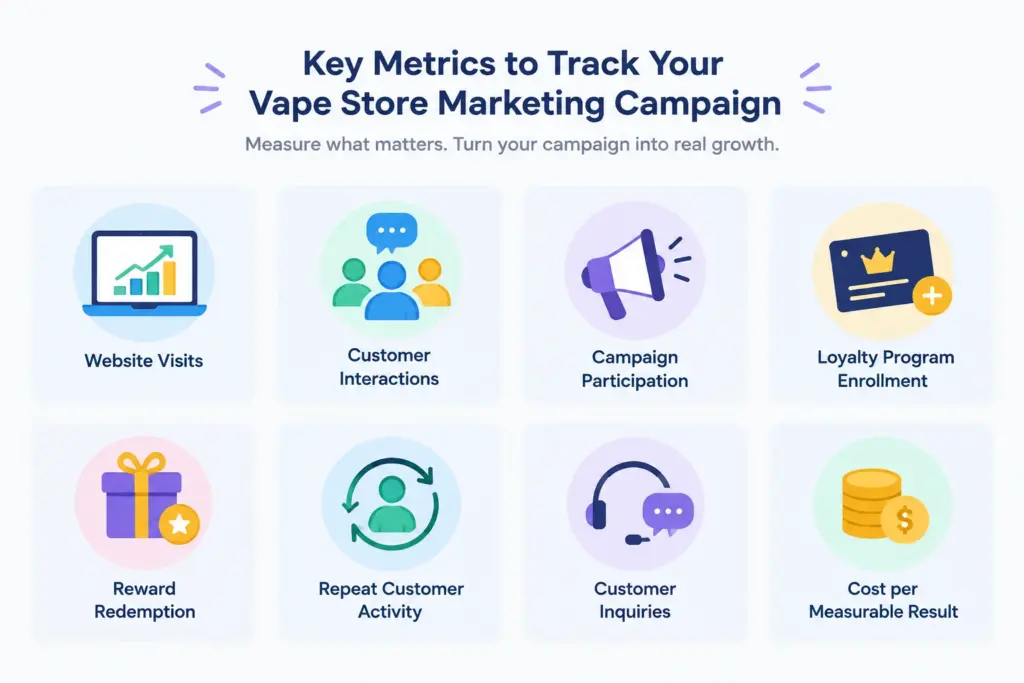
The right metric depends on the campaign goal. For example, if the focus is customer loyalty, enrollment and ongoing engagement may tell you more than basic reach. If the objective is website visibility, website activity may be more relevant.
Establish a Campaign Timeframe
A campaign also needs a defined beginning and end. Without a timeframe, it is easy for a campaign to become an ongoing activity that nobody properly reviews.
I usually recommend establishing:
- A clear launch date
- A defined campaign period
- Check-in points during the campaign
- A final measurement date
- A post-campaign review
The timeframe should give you enough opportunity to collect meaningful data without allowing an underperforming campaign to continue indefinitely.
It is also worth remembering that early numbers do not always tell the whole story. I prefer looking at campaign performance over an appropriate period and comparing the results with the original objective before making changes.
Connect Your Goals With the Customer Journey
Your campaign goal should also fit naturally into the customer journey. Think about what you want an eligible customer to do after encountering your campaign.
That journey might involve:
Campaign exposure → Information → Store interaction → Customer action → Follow-up → Retention
This is particularly useful when customer retention or a Vape Store Loyalty Program is part of the broader strategy. Instead of treating the campaign as a one-time interaction, you can consider how the customer relationship develops afterward, where permitted.
Keep Your Campaign Goal Focused
Once the objective, KPIs, and timeframe are established, the next step becomes much easier. You know what you are trying to accomplish, what information to collect, and what results deserve attention.
From my experience, that clarity is often what separates a campaign that simply creates activity from one that gives a business useful information for its next Vape Store Marketing decision. In the next section, we’ll look at how to define the eligible audience and create a campaign message that is relevant, responsible, and consistent.
Understand Your Audience and Build the Right Campaign Message
Once the campaign goal is clear, I move to the next question: Who exactly is this campaign meant to reach? A strong Vape Store Marketing strategy is not about trying to communicate with everyone. It starts with defining the eligible audience, understanding their needs, and creating a message that is clear, accurate, and appropriate for the market you operate in.
Define Your Eligible Audience
Before thinking about creative ideas or marketing channels, I first look at who can legally receive the communication. Vape and nicotine-related marketing can be subject to age restrictions, advertising rules, and local requirements, so audience definition should come before campaign development.
Depending on your location and applicable regulations, consider:
- Required minimum age for customers
- Geographic restrictions
- Applicable advertising requirements
- Platform-specific audience restrictions
- Whether your communication reaches audiences outside your intended market
- Age verification requirements where applicable
This step is particularly important because a campaign can have strong engagement numbers and still create compliance problems if it reaches the wrong audience.
Identify Customer Needs and Questions
After defining the eligible audience, I look at what customers actually want to know. This is where customer behavior, questions, feedback, and previous interactions can become useful.
For example, customers may have questions about:
- Store information
- Product availability where legally applicable
- General product information
- Loyalty program participation
- Reward points and redemption terms
- Store policies
- Customer support
I find that reviewing real customer questions often gives me better campaign ideas than simply following marketing trends. Those questions show where customers need clearer information.
Decide What Your Shop Wants to Communicate
With the audience and customer needs established, you can decide what the campaign should communicate. Rather than trying to explain everything in one message, I prefer choosing a central theme and building supporting content around it.
Your message might focus on:
- Customer experience
- Store convenience
- Customer service
- General educational information
- Store updates
- Customer loyalty
- Information about a Vape Store Loyalty Program, where permitted
A consistent message also makes it easier to create related website content, emails, in-store materials, or other approved communications.
Keep Campaign Messaging Responsible and Accurate
This is an area where I always recommend taking an extra moment before publishing. Every campaign message should be accurate and comply with the laws and advertising rules that apply to your location.
Avoid:
- Unsupported product or health claims
- Messaging that could appeal to minors
- Misleading promotional statements
- Unclear eligibility requirements
- Claims that cannot be substantiated
If your campaign includes loyalty rewards or a customer loyalty program, explain eligibility, terms, and restrictions clearly rather than hiding important information in fine print.
Create a Message That Supports the Campaign Goal
Your audience and message should ultimately connect back to the objective you established in Section 1. If the campaign focuses on customer engagement, the message should encourage an appropriate interaction. If it focuses on customer retention, it should support the relevant relationship-building activity where legally permitted.
I’ve found that this simple connection keeps campaigns much more focused. Instead of asking, “What should we promote?”, you can ask, “What useful message supports our campaign goal for the eligible audience?”
Once the audience and message are clear, you have a much stronger foundation for choosing marketing channels and building the campaign itself. Next, we’ll look at how to select appropriate channels and turn your message into a structured campaign.
Choose Your Marketing Channels and Build the Campaign
Once I know the campaign objective, audience, and core message, I can decide where the campaign should appear. This is where a lot of businesses jump too quickly into posting or advertising. I prefer taking a step back and asking which marketing channels are actually appropriate, legally permitted, and capable of reaching the intended audience.
Review Which Channels Are Legally Available
Not every channel can be used in the same way for vape or nicotine-related businesses. Before launching a campaign, check the rules that apply to your location and the current policies of each platform.
Depending on local requirements, your options may include:
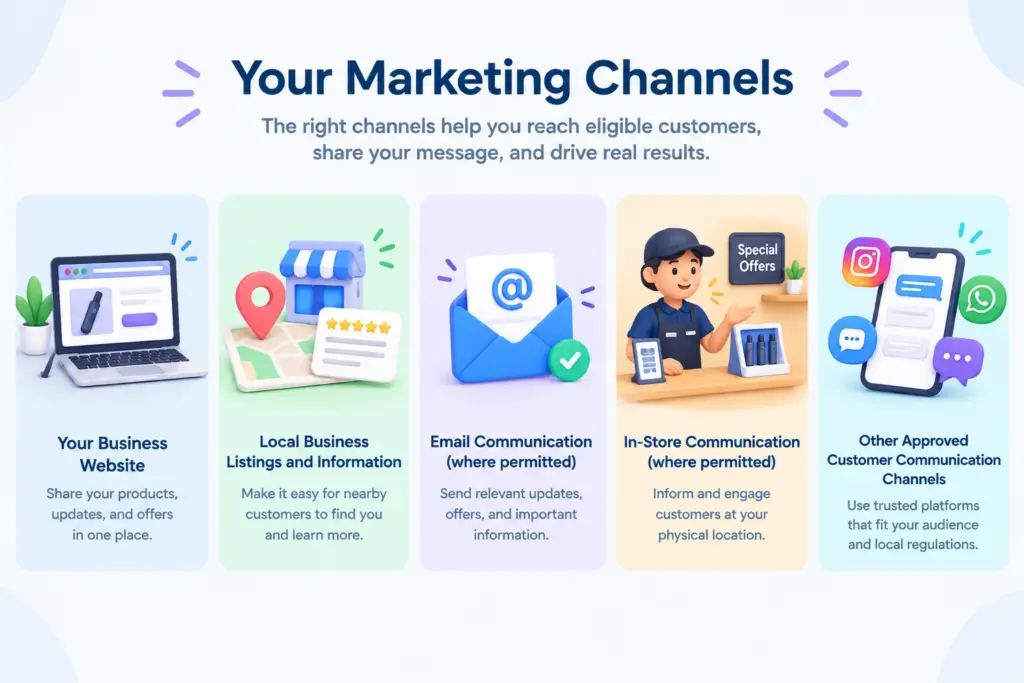
For me, this check is essential. A channel may look useful from a general Vape Store Marketing perspective, but its advertising policies may restrict specific products, audiences, or promotional content.
Check Advertising and Platform Restrictions
I always recommend reviewing the rules before creating campaign assets, not after. This saves time and prevents you from building an entire campaign around a channel that cannot be used for your intended purpose.
Before publishing, check:
- Applicable local advertising regulations
- Age-related requirements
- Platform advertising policies
- Geographic restrictions
- Promotional limitations
- Required disclaimers or eligibility information
Keep a record of these checks so your team has a clear reference when reviewing future campaigns.
Create a Consistent Campaign Structure
Once the channels are confirmed, I build the campaign around a simple structure. Every piece of communication should support the same central objective rather than feeling like a collection of unrelated messages.
A basic structure can include:
- Campaign message
- Supporting content
- Appropriate call to action
- Website or approved destination
- Campaign timeframe
- Campaign tracking method
If a Vape Store Loyalty Program is part of the campaign, make sure information about loyalty rewards, eligibility, and participation is consistent everywhere it appears.
Create a Simple Campaign Calendar
I’ve found that even a basic calendar can make campaign execution much easier. It gives everyone a clear view of what needs to happen and when.
Your calendar can include:
- Pre-launch preparation
- Campaign launch
- Performance monitoring
- Mid-campaign review
- Final measurement
- Post-campaign analysis
Prepare Campaign Assets Before Launch
Finally, prepare the necessary materials before the campaign goes live. This might include website content, approved communications, in-store materials, customer-service responses, and campaign terms.
Taking this preparation seriously makes the launch smoother and gives you more time to focus on customer engagement and campaign performance once the campaign is active.
With your channels selected and campaign assets ready, the next step is to connect everything into a clear customer journey that guides eligible customers through each stage of the campaign.
Make the Customer Journey Part of Your Campaign Plan
Once the campaign is live, I don’t look at each interaction as a separate event. I look at the complete customer journey. This helps me understand what happens after someone first encounters the campaign, what information they need next, and where the experience may become unclear. For a Vape Store Marketing campaign, this approach can also help connect customer engagement, customer retention, and a Vape Store Loyalty Program into a more organized process where legally permitted.
Map the Customer Journey
I usually start by putting the customer journey into a few simple stages. You don’t need a complicated diagram. You just need to understand what happens from the first interaction onward.
A basic journey might look like:
Campaign exposure → Information → Store interaction → Customer action → Follow-up → Retention
At each stage, ask what the customer needs and what your business should provide. For example, someone who sees campaign information may need additional store details before deciding whether to interact further.
This prevents your campaign from focusing only on the initial message while ignoring everything that happens afterward.
Make Each Stage Easy to Understand
One thing I’ve noticed when reviewing customer journeys is that confusion often happens between stages. A campaign may communicate one thing clearly, but the next step may be difficult to understand.
To create a smoother experience:
- Provide clear and accurate information
- Keep important eligibility requirements visible
- Make relevant terms easy to find
- Avoid unnecessary steps
- Keep campaign messaging consistent
- Make the next appropriate action clear
If a campaign includes a customer loyalty program, explain how eligible customers can participate, how loyalty rewards work, and any applicable conditions.
Prepare for Customer Questions
A campaign can generate questions that you did not anticipate. I’ve found that these questions are often valuable because they show exactly where the campaign communication could be clearer.
Depending on the campaign, customers may ask about:
- Store information
- Product availability where legally applicable
- Campaign eligibility
- Reward points
- Loyalty program participation
- Redemption conditions
- Customer support
Create clear responses for common questions so your team does not have to improvise every time. This also creates a more consistent customer experience.
Create a Responsible Follow-Up Process
Follow-up should have a purpose. I don’t recommend sending messages simply because you can. Communication should be appropriate, permission-based where required, and consistent with applicable privacy and marketing regulations.
A responsible follow-up process can include:
- Communicating only through permitted channels
- Respecting customer communication preferences
- Providing an easy opt-out where applicable
- Following age-related requirements
- Avoiding excessive communication
- Keeping customer information appropriately protected
For a Vape Store Loyalty Program, follow-up may involve permitted updates about membership or rewards, provided the communication complies with applicable requirements.
Know When the Campaign Should Stop
Every campaign needs stopping points. These might include the planned end date, a compliance concern, an unexpected customer response, or a change in applicable rules.
I like to establish these conditions before launch because it removes uncertainty later. It also makes the campaign easier to manage when circumstances change.
When the customer journey is mapped clearly, you can see more than whether people responded to your campaign. You can identify where they needed information, where engagement slowed, and where your process can improve. Next, we’ll look at how to measure those results and turn them into useful insights for your next campaign.
Measure Campaign Performance and Improve the Next Campaign
Launching a campaign is only half the job. Once it is running, I want to know what actually happened. Did the campaign support its original objective? Did eligible customers engage with it? Did the customer journey work as expected? Measuring these details turns a one-time Vape Store Marketing campaign into a learning opportunity that can improve future campaigns.
Track the Metrics That Match Your Goal
I always start by returning to the objective we established at the beginning. There is little value in collecting dozens of numbers if they do not tell you whether the campaign achieved its purpose.
Depending on the campaign, useful marketing metrics may include:
- Website visits
- Eligible customer interactions
- Campaign participation
- Customer engagement
- Loyalty program enrollment
- Reward redemption where legally permitted
- Repeat customer activity
- Customer inquiries
- Cost per measurable result
For example, if a campaign supports a Vape Store Loyalty Program, enrollment and ongoing engagement may be more useful than simply measuring how many people viewed the campaign.
Compare Results With Your Original Objectives
Once the campaign ends, I compare the results against the goals I set before launch. This is where having a clear objective becomes extremely useful.
Ask questions such as:
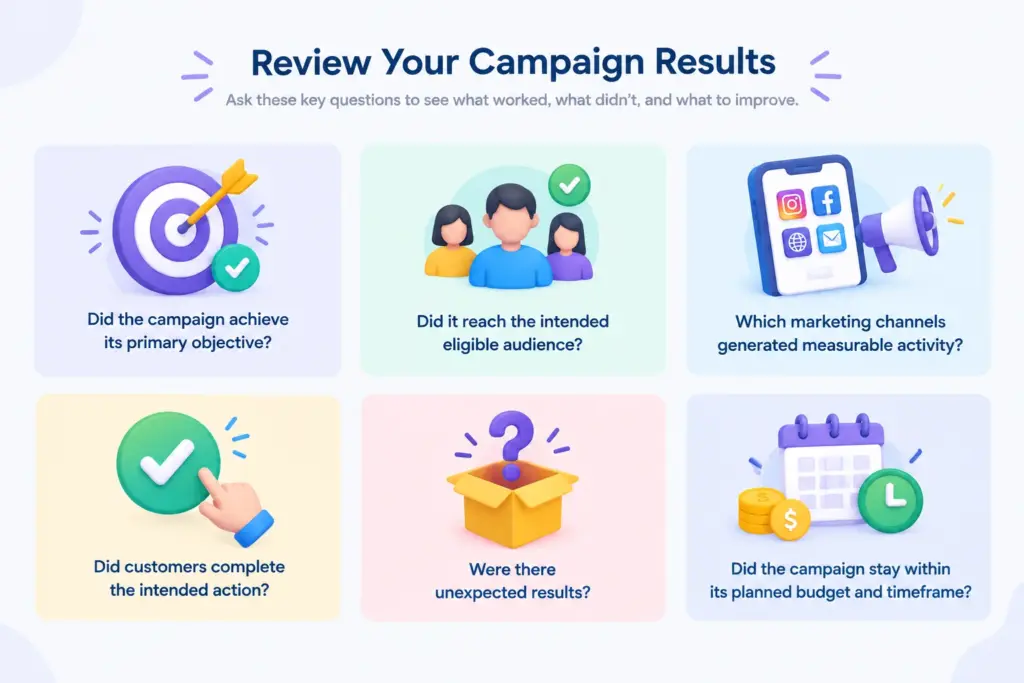
I avoid judging a campaign based on one number alone. A campaign can generate strong engagement but fail to support its main objective, while another may produce fewer interactions but provide more meaningful results.
Look for Customer Behavior Patterns
Numbers tell you what happened, but customer behavior can help explain why. I like to review questions, interactions, and customer feedback alongside campaign metrics.
Look for patterns such as:
- Frequently asked questions
- Common points of confusion
- High-interest campaign elements
- Customer drop-off points
- Repeated requests for information
- Engagement with loyalty rewards
- Changes in repeat customer activity
These observations can reveal gaps that a standard performance report might miss.
Identify What Needs to Change
The purpose of measurement is not simply to produce a report. It is to decide what can be improved.
Based on the results, you may need to adjust:
- Campaign messaging
- Marketing channels
- Campaign timing
- Customer communication
- Website content
- Customer journey
- Tracking methods
- Customer retention processes
I’ve found that small changes can sometimes make the next campaign much easier to manage. If customers repeatedly ask the same question, for example, that may indicate that the campaign message or supporting content needs clarification.
Document Lessons for the Next Campaign
Finally, I recommend creating a simple record of what you learned. Note which activities were useful, which created unnecessary work, what questions customers asked, and which campaign performance indicators were most informative.
You can document:
- Campaign objective
- Key results
- Successful activities
- Problems encountered
- Customer feedback
- Compliance considerations
- Recommended changes
- Metrics to track next time
This creates a repeatable marketing strategy instead of forcing you to start from scratch every time. A well-documented campaign can also help your team make more consistent decisions when planning future Vape Store Marketing activities.
The real value of a campaign is not just what happens during its active period. By measuring results, studying customer behavior, and documenting what you learned, you create a stronger foundation for the next campaign while keeping your strategy focused, measurable, and adaptable.
Starting a successful Vape Store Marketing campaign is much easier when you have a clear process behind it. In this guide, we covered how to define campaign goals, understand your eligible audience, choose appropriate marketing channels, build a smoother customer journey, and measure campaign performance.
We also looked at how customer engagement, customer retention, and a Vape Store Loyalty Program can support a broader marketing strategy where legally permitted. The key is to keep your campaigns focused, measurable, responsible, and aligned with applicable requirements.
If you’re exploring ways to organize loyalty rewards, reward points, and customer loyalty initiatives, Happyrewards.io can be another resource to explore. Ultimately, the best campaign is one you can measure, learn from, and improve with every new cycle.
