
- Happy Rewards
- March 13, 2026
Hybrid Loyalty Programs: Why Brands Are Combining Multiple Reward Models?
Back in the day, I’d grab a punch card, get my tenth coffee free, and call it loyalty. But today? Customers are smarter, pickier, and expect more.
The problem? Pure points-based systems feel transactional and boring after a while. Pure tiered membership can leave casual shoppers out. Enter hybrid loyalty programs — blending multiple models so everyone wins.
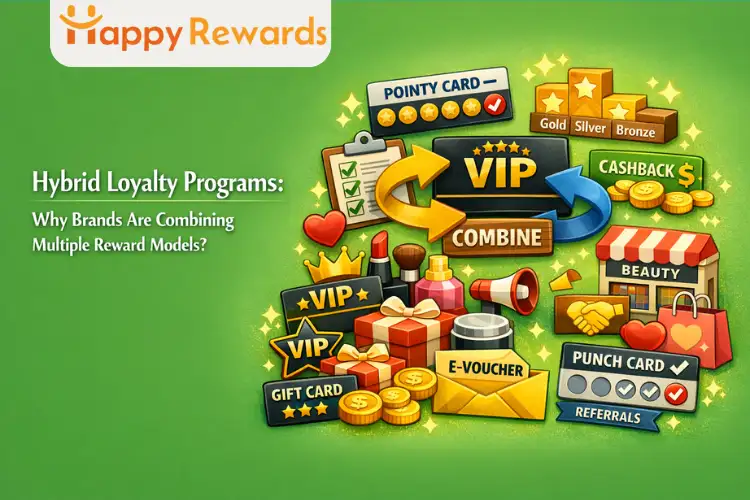
Think points-based systems + tiered membership + gamified engagement + experiential rewards. Brands like Starbucks and Sephora are killing it with this mix, driving higher retention rate, lower churn rate, and real brand affinity.
In this guide, we’ll chat through why hybrids are taking over in 2026, look at killer examples, weigh the pros/cons, and walk you step-by-step on building one for your own business — whether you’re running an e-commerce store, retail spot, or direct-to-consumer (DTC) brand. Platforms like HappyRewards.io make it super easy to mix these elements without a headache.
Ready? Let’s dive in and see how you can turn one-time buyers into lifelong fans.
So there you have it — hybrids aren’t just a trend; they’re the smart way to fight rising acquisition costs and build lasting connections. Stick around as we unpack exactly what makes them tick.
What Are Hybrid Loyalty Programs?
Picture your favorite coffee run again. You earn loyalty points for every purchase (points-based systems), climb status levels for perks like free refills (tiered membership), complete fun challenges for bonus stars (gamified engagement), and get invited to exclusive tastings or events (experiential rewards).
- That’s a hybrid loyalty program — one system mashing up 2+ reward models so it feels fresh and personal for every kind of customer.
- Unlike old-school single plays (just points or just cashback), hybrids mix things up: points-based systems + tiered membership, gamified engagement + experiential rewards, even coalition loyalty with partners or referral bonuses.
- The goal? Hit different motivations — some folks love quick transactional wins (transactional loyalty), others crave that emotional connection (emotional loyalty) and sense of belonging (brand affinity).
- This blend lets you map the full customer journey better, collecting zero-party data through fun interactions while delivering personalized incentives that feel spot-on.
- It’s why hybrids shine in omnichannel loyalty setups — seamless from app to in-store, with mobile app integration and push notifications keeping everyone hooked.
Check out our guide on building true omnichannel loyalty if you want to go deeper there.
Bottom line: Hybrids make your program feel alive and relevant, not like a chore. And that’s huge when customers have endless choices.
Why Brands Are Shifting to Hybrid Loyalty Programs in 2026?
Okay, friend, let’s get real — why are so many brands ditching the “one-trick” loyalty pony and going full hybrid in 2026? It boils down to this: customers aren’t one-size-fits-all anymore.
Some want quick wins like a discount right now (transactional loyalty), while others crave that deeper connection — feeling seen, valued, and part of something bigger (emotional loyalty and brand affinity).
Primary Reasons
Rising customer acquisition costs are brutal — we’re talking 5–25x more expensive than keeping someone around. A tiny 5% bump in customer retention can skyrocket profits by 25–95% (Harvard Business Review still holds strong, and recent reports back it up).
Loyal customers spend more, refer friends (referral bonuses pay off), and stick around longer, pumping up customer lifetime value (CLV) and slashing churn rate.
Single-model programs? They’re getting stale. Pure points-based systems feel like chores after a while. Basic cashback offers spark price wars. But hybrids? They let you appeal to everyone:
- More personalized incentives and hyper-personalization through data-driven marketing and behavioral analytics.
- Higher engagement with gamified engagement (badges, leaderboards, challenges) and experiential rewards (events, early access).
- Better omnichannel loyalty — seamless across app, store, social, with mobile app integration, push notifications, and POS integration.
- Stronger brand advocacy and community building via user-generated content (UGC) and social media integration.
- Real data wins: Collect zero-party data for smarter AI-powered personalization without creeping people out.
Stats show hybrids deliver: Programs blending models see higher redemption rate, retention rate, and ROI. In saturated markets, it’s the edge that turns casual shoppers into superfans.
Hybrids aren’t fancy — they’re practical. They meet customers where they are, boost metrics that matter, and make your brand feel irreplaceable.
So yeah, 2026 is the year of the hybrid shift. Now let’s look at some brands doing it right — you’ll see exactly how this plays out in the real world.
These examples aren’t just inspiring; they’re proof that mixing models works. Grab your notes — the patterns here are gold for your own program.
Top Hybrid Loyalty Program Examples from Leading Brands
Let’s geek out on the stars of the show. These brands aren’t just running loyalty programs — they’re mastering hybrids and reaping massive rewards.
Starbucks Rewards
They blend points-based systems (earn Stars per dollar), tiered membership (now Green, Gold, Reserve levels with faster earning and no-expiry perks for higher tiers — rolled out big in March 2026), gamified engagement (challenges, bonus Stars, Double Star Days), and experiential rewards (exclusive events, personalized offers).
The app is king — mobile app integration, push notifications, seamless payments. Result? Over 34 million active members driving huge repeat visits and higher spend. It’s the blueprint for frictionless, fun loyalty.
Sephora Beauty Insider
This one’s a hybrid masterpiece — points-based systems (1 point per dollar, redeemable in the Rewards Bazaar for products/samples), tiered membership (Insider free, VIB at $350/year, Rouge at $1,000/year with escalating perks like exclusive events and higher bonuses), plus heavy experiential rewards (makeup classes, birthday gifts, early access launches).
It builds member exclusivity and VIP perks, turning shoppers into advocates. Higher tiers mean more emotional loyalty — and yes, massive CLV lifts (some reports show 30–40% jumps in spend).
Nike Membership
Then there’s Nike Membership (free entry). They mix gamified engagement (challenges, badges via apps), experiential rewards (early product drops, athlete events, custom designs), and community vibes (social media integration, training tips).
Less about points, more about passion — it fosters brand advocacy and community building. Perfect for direct-to-consumer (DTC) brands wanting deeper connections beyond transactions.
The lesson? These hybrids balance quick wins with long-term feels. They drive repeat purchase, higher average order value, and true fans.
Pros and Cons of Hybrid Loyalty Programs
Alright, let’s keep it real — nothing’s perfect. Hybrids are powerful, but they’re not magic buttons. I’ve seen brands jump in excited and then hit a few bumps, so let’s talk openly about the good, the tricky, and how to handle it.
The pros are honestly huge
- Super flexibility — you can serve casual shoppers who want quick cashback offers or points-based systems AND your VIPs who crave member exclusivity, VIP perks, and experiential rewards.
- Way higher customer engagement and gamified engagement — people actually play, share, and come back because it’s fun, not forced.
- Deeper emotional loyalty and brand affinity — mixing transactional wins with surprise-and-delight moments turns customers into brand evangelists.
- Better customer retention, lower churn rate, and seriously boosted customer lifetime value (CLV) — studies show blended programs often lift retention 20–30% (McKinsey loyalty insights).
- Stronger data game — you collect richer zero-party data, behavioral analytics, and purchase history for smarter AI-powered personalization and predictive modeling.
- True omnichannel loyalty — works beautifully across in-store experience, e-commerce, app, social — with seamless UX, real-time gratification, and cross-channel consistency.
The cons exist
- It can get confusing if rules are messy — too many ways to earn/redeem leads to low redemption rate or frustrated members.
- Setup takes more thought and tech — you need solid CRM integration, API connectivity, and POS integration to avoid glitches.
- Risk of overwhelming your team or customers if you overdo it — think “feature creep” in the member portal.
The fix? Start simple (maybe just points-based systems + tiered membership), test with a small group, and use user-friendly platforms.
We’ve got a quick read on avoiding common loyalty mistakes if you want to dodge the pitfalls early.
So pros outweigh cons when done thoughtfully. Now let’s get practical — how do you actually build or upgrade to a hybrid without losing your mind?
You’ve seen the upsides and the traps — time to roll up our sleeves and walk through the steps so you can launch something awesome.
How to Build or Upgrade to a Hybrid Loyalty Program (Step-by-Step)
Friend, this is the part where the rubber meets the road. Building a hybrid doesn’t have to be scary — break it into clear steps, and you’ll have something that actually moves the needle on retention rate and revenue.
Step 1: Audit your current setup & know your people
Dig into your data — purchase history, consumer behavior, frequency of purchase, average order value. Map the customer journey and touchpoints. Who are your segments? Bargain hunters? Loyal superfans? Use customer segmentation and psychographic profiling to see what motivates each group.
Step 2: Set crystal-clear goals & KPIs
What do you want? 20% higher retention rate? 15% lift in CLV? Better net promoter score? Track redemption rate, churn reduction, ROI tracking, and conversion rate.
Step 3: Pick your hybrid mix wisely
Start simple: points-based systems + tiered membership is the most common winner. Add gamified rewards (badges, leaderboards, progression bars) or experiential rewards (birthday rewards, surprise and delight). Maybe toss in referral bonuses or coalition loyalty later.
Step 4: Design rewards that feel valuable
Balance transactional loyalty (discounts, cashback) with emotional loyalty (lifestyle rewards, non-monetary incentives). Include welcome gift, anniversary reward, early access.
Step 5: Make it seamless & mobile-first
Prioritize mobile-first strategy, mobile app integration, digital wallets, contactless payments, QR code rewards, and POS integration. Ensure omnichannel loyalty and cross-channel consistency.
Step 6: Launch smart, promote, and iterate
Soft-launch to test. Use push notifications, email marketing, behavioral triggers, and segmenting to drive enrollment. Gather feedback loop and run re-engagement campaigns or win-back strategies.
There you go — a straightforward path. Start small, listen to your customers, and watch the loyalty grow.
Conclusion
Whew, friend — we’ve walked through why hybrid loyalty programs are stealing the show in 2026: blending points-based systems, tiered membership, gamified engagement, experiential rewards, and more to create real customer retention, sky-high customer lifetime value (CLV), and genuine brand loyalty.
One-size-fits-all is out. Hybrids win because they meet people where they are — transactional or emotional — across every touchpoint with omnichannel loyalty and seamless UX. Brands like Starbucks and Sephora prove it: mix models right, and you get superfans, not just repeat buyers.
The future? Even more personalized, sustainable, and instant — powered by AI-powered personalization, zero-party data, and smart ecosystems. Don’t wait for it to pass you by.
Ready to build a hybrid loyalty program that fits your brand perfectly? HappyRewards.io makes it straightforward — launch customizable points, tiers, gamification, experiential perks, mobile app integration, API-driven loyalty, and POS integration without the tech headaches. Start your free trial today or book a quick demo — let’s turn your customers into lifelong fans.
What hybrid elements are you thinking of adding first? Drop a comment below — I’d love to hear your challenges or wins. You’ve got this!
Thanks for hanging out through the whole guide. Go make some loyalty magic happen.
