
- Happy Rewards
- October 12, 2026
Loyalty Programs Without Apps or Phone Numbers: How They Work
Have you ever skipped a loyalty program because you did not want to download another app or share your phone number just to earn a reward? Many customers prefer simple ways to collect points, unlock discounts, and enjoy special offers without adding extra steps to their shopping experience.
For businesses, this creates an important opportunity. A loyalty program should make customers feel appreciated, not make earning rewards feel like a chore. By offering convenient alternatives such as QR codes, digital loyalty cards, and supported mobile wallet passes, businesses can make participation easier while encouraging customers to return.
The good news is that loyalty programs do not always need a dedicated mobile app or a phone number as the primary customer identifier. The exact setup depends on the platform, but businesses have several options for creating a more accessible rewards experience.
In this guide, we will explore how these programs work, which loyalty models businesses can consider, how to respect customer privacy, and what makes a reward system worth joining. We will also look at how HappyRewards.io can support businesses exploring digital loyalty experiences.
Why Customers Prefer Loyalty Programs With Fewer Signup Requirements
Customers generally join loyalty programs because they want something valuable in return for their continued support. However, the process of signing up can influence whether they participate at all. If enrollment requires downloading an app, creating an account, remembering another password, or sharing personal details, some customers may decide that the reward is not worth the effort.
Convenience Makes Joining More Appealing
Think about a customer visiting a neighborhood coffee shop before work. They might be happy to collect stamps toward a free drink, but they probably do not want to spend several minutes completing a registration form while other people wait in line.
A simple enrollment process can remove this barrier. For example, a business might display a QR code at the counter that directs customers to its digital loyalty experience. Depending on the platform, customers may be able to access their card through a browser or add a supported pass to their mobile wallet.
The fewer unnecessary steps customers encounter, the easier it becomes to introduce them to the program. Businesses should still explain any required registration or verification steps clearly.
Customers Want More Control Over Their Personal Information
Phone numbers are often used to identify loyalty members, but not everyone wants to share one with every business they visit. Some customers may prefer not to receive promotional texts, while others simply want to keep their contact details private.
Offering alternative participation methods gives customers more choice. Depending on the loyalty system, these alternatives might include a digital card, a unique membership identifier, or a supported wallet pass.
Businesses should distinguish between joining a program and consenting to marketing messages. Collecting information for membership purposes does not automatically mean customers have agreed to receive promotional communications.
A Simple Experience Can Encourage Repeat Visits
Convenience is only one part of a successful loyalty strategy, but it can help customers engage with rewards more consistently. When people can access their loyalty cards easily and understand how to earn benefits, they have fewer obstacles to participating.
Consider a salon that rewards customers after a set number of appointments. A clear digital stamp card can help customers see their progress and understand how close they are to their next reward. A local bakery could use a similar approach to encourage regular purchases.
For businesses, the objective is straightforward: make rewards easy to understand, convenient to access, and worthwhile to earn. A well-designed program combines that simplicity with reliable reward tracking and clear customer privacy practices.
App-Free vs. Phone-Free Loyalty: What Is the Difference?
When I discuss loyalty programs with business owners, I think it is important to separate two ideas that often get treated as the same thing: running a program without an app and running one without a phone number. They sound similar, but they solve different problems. Understanding the distinction helps businesses choose a setup that works for their customers instead of simply following a trend.
What Does an App-Free Loyalty Program Mean?
An app-free loyalty program allows customers to participate without installing a dedicated mobile application. Instead, they might access their rewards through a website, a QR code, a digital card, or a supported mobile wallet.
For example, imagine a small clothing boutique that wants to reward repeat customers. Rather than asking every shopper to download an app, the store could provide a QR code that opens its digital loyalty experience. Customers can then follow the available instructions to join and access their rewards.
I find this approach particularly practical for businesses where customers make quick purchases or visit several different stores throughout the week. Most people already have plenty of apps on their phones, so removing the need for another download can make a loyalty program more appealing.
However, app-free does not necessarily mean registration-free. A platform might still ask customers to create an account or provide an email address before they can collect rewards.
What Does a Phone-Free Loyalty Program Mean?
A phone-free loyalty program does not require customers to provide their phone numbers to join or participate. Depending on how the program is designed, it may use a unique loyalty card, a membership ID, or another method to recognize customers and track their rewards.
Consider a customer who regularly visits a neighborhood bakery but prefers not to share personal contact details. The bakery could offer a physical stamp card or a suitable digital alternative that does not rely on a phone number for identification.
The important consideration is how the business records purchases and prevents reward balances from being lost, duplicated, or assigned to the wrong customer. A physical card, for example, may be easy to use, but replacing a lost card can be difficult if the system has no way to recover the customer’s progress.
I would therefore evaluate phone-free options based on both privacy and practicality. Avoiding unnecessary data collection is valuable, but customers should still have a reliable way to access the benefits they earn.
Can a Loyalty Program Be Both App-Free and Phone-Free?
Yes. A loyalty program can be designed to avoid both a dedicated app and mandatory phone-number collection. However, the available options depend on the provider, its enrollment process, and its reward-tracking system.
Here is a simple comparison: Different loyalty programs have different enrollment requirements. Some rely on dedicated apps or phone numbers, while others use physical stamp cards, digital loyalty cards, or mobile wallet passes. The table below compares these options to help businesses choose an approach that makes rewards convenient and accessible for customers.
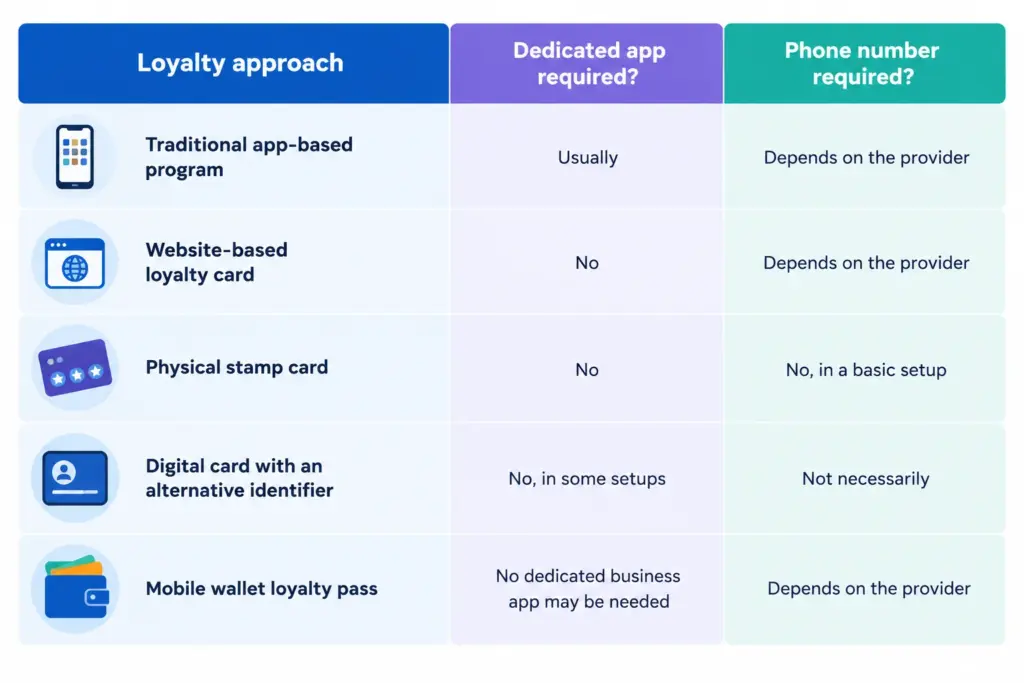
As I see it, businesses should avoid assuming that every digital loyalty solution offers the same level of flexibility. A QR code may open a website, but that website could still require registration. Similarly, adding a card to a mobile wallet does not automatically eliminate the need for customer identification.
For businesses exploring digital options, HappyRewards.io is worth considering for its digital loyalty approach, including QR code experiences and mobile wallet support. Before promising customers that they can join without a phone number, I would verify the platform’s current enrollment requirements and available identification methods.
Ultimately, the right choice depends on what matters most to your customers. If the goal is to eliminate app downloads, browser-based cards may be sufficient. If the goal is to avoid phone-number collection as well, the business needs to confirm that its loyalty system supports an appropriate alternative.
Exploring Loyalty Options That Do Not Require an App or Phone Number
When I look at the different ways businesses can reward returning customers, I do not think there is one solution that works for everyone. A coffee shop with daily regulars has different needs from a clothing boutique or a salon where customers might visit once every few weeks. The best approach depends on how often customers return, how rewards are earned, and how much effort the business wants customers to put into joining.
Fortunately, businesses have several options to explore without making a dedicated app or phone number a mandatory part of the experience.
Physical Loyalty Cards for Simple Reward Tracking
Physical loyalty cards remain a practical option for businesses that want to keep their reward systems straightforward. Customers receive a card and collect stamps or punches whenever they make a qualifying purchase.
For example, a neighborhood café might offer one stamp for each eligible coffee purchase. After collecting eight stamps, the customer receives a free drink. There is no need to download an app or provide a phone number to participate in a basic program like this.
I can see why this approach still appeals to small businesses. It is easy to explain, familiar to customers, and relatively simple to introduce at the counter.
However, physical cards have limitations. Customers can lose them, forget to bring them, or accidentally damage them. Businesses also have fewer opportunities to understand overall program performance unless they maintain additional tracking methods. For a business that wants to move beyond basic stamp collection, a digital alternative may be worth exploring.
QR Code-Based Loyalty Programs
QR codes offer another way to make loyalty enrollment more convenient. A business can display a code on its counter, receipts, packaging, or promotional materials. Customers scan it with their phones to open the relevant loyalty page or experience.
What I particularly like about this approach is its flexibility. A salon could place a QR code at reception, while a restaurant could display one near the checkout area. Customers can discover the program at the moment they are already interacting with the business.
QR codes can make loyalty programs easier to access, but their purpose depends on how the business sets them up. As the image illustrates, scanning a QR code may open a sign-up page, a digital loyalty card, or a rewards page. Businesses should check the registration requirements to confirm whether customers can participate without providing a phone number.
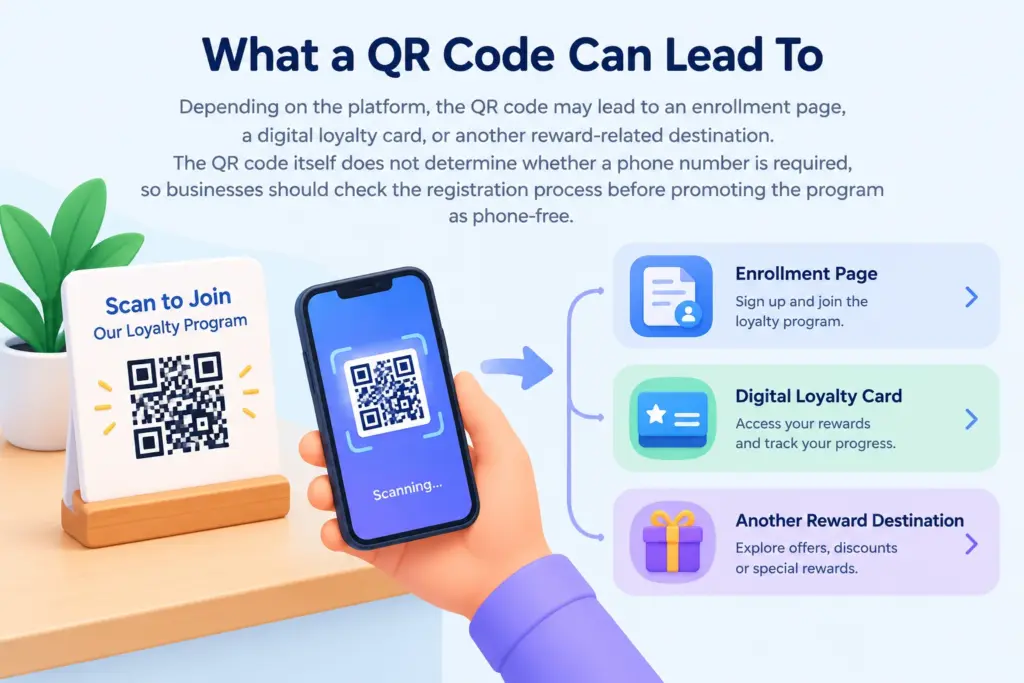
QR codes can also make digital loyalty programs easier to promote across different customer touchpoints. With a suitable system behind them, they provide a convenient entry point without requiring a dedicated business app.
Digital Loyalty Cards and Mobile Wallet Passes
Digital loyalty cards bring familiar rewards into a format customers can access on their phones. Instead of carrying a separate paper card, customers may be able to open their loyalty card digitally or save a supported pass in Apple Wallet or Google Wallet.
For example, a customer visiting a clothing store could access a digital membership card when making another purchase. If the program supports it, the card might display membership details or reward information that helps the customer understand their benefits.
From a business perspective, digital cards can reduce dependence on printed materials and make loyalty information easier to access. They can also support a more consistent customer experience across repeat visits.
There is an important distinction, though. A digital loyalty card is not automatically anonymous, and mobile wallet integration does not guarantee that a customer can join without an account or phone number. Those requirements depend on the platform and its configuration.
For businesses considering this route, HappyRewards.io offers a digital loyalty approach that includes QR code experiences and mobile wallet support. I would assess the available enrollment options, reward features, and customer identification requirements before choosing the exact setup.
Browser-Based Loyalty Experiences
Another option is a loyalty experience that customers can access through a mobile browser rather than installing an application. This can be useful for businesses that want to offer digital rewards while keeping the process familiar.
Imagine a local bakery promoting its rewards program through a QR code at the checkout counter. A customer scans the code, opens the linked page, and follows the available instructions to participate. Depending on the system, the customer may be able to access the experience again through a saved link or another supported method.
I see browser-based access as a useful way to reduce friction, especially for customers who prefer not to install additional software. However, the business still needs a reliable way to record qualifying purchases and connect them to the correct loyalty record.
Before selecting a solution, I would compare these options against three practical questions: How easily can customers join? How reliably can rewards be tracked? And can customers access their rewards again without unnecessary effort?
Answering those questions will help businesses choose a loyalty model that fits their customers instead of adding digital features simply for the sake of having them.
How to Make Joining a Loyalty Program Easier for Customers
I believe one of the biggest mistakes businesses make with loyalty programs is focusing too much on the rewards and not enough on the experience of joining. A generous discount or a free product might attract attention, but customers still need a simple way to sign up, understand the rules, and start earning benefits. If the process feels confusing, some will walk away before they experience any value.
When I think about a well-designed loyalty program, I look at it from the customer’s point of view first. Can someone understand the offer in a few seconds? Do they know what to do next? And can they access their rewards without unnecessary hassle? These questions are worth answering before a business launches its program.
Keep Enrollment Short and Straightforward
Imagine a customer standing at the checkout counter of a busy coffee shop. The cashier mentions a loyalty program that offers a free drink after several qualifying purchases. The customer is interested, but then hears that joining involves downloading an app, completing a lengthy form, and verifying multiple details.
Personally, I would see that as a missed opportunity. The customer has already shown interest, so the business should make the next step as easy as reasonably possible.
A QR code that opens a clear enrollment page can help reduce friction. Depending on the platform, customers may be able to access a digital loyalty card or follow a short registration process without downloading a dedicated app. If the program does not require a phone number, make sure the chosen system genuinely supports that arrangement.
I would also avoid asking for information that the business does not need. Every additional field creates another decision for the customer, so keep the signup process focused on what is necessary to operate the program.
Explain the Rewards Before Asking Customers to Join
Another thing I would prioritize is clarity. Customers should not have to guess how a loyalty program works or search through complicated terms to understand what they will receive.
For example, a bakery could display a simple message explaining that customers earn one stamp for every qualifying purchase and receive a free pastry after collecting eight stamps. That is much easier to understand than a vague promise of exclusive benefits.
The same principle applies to points-based programs. Explain how points are earned, whether any purchases are excluded, and what customers need to do to redeem their rewards. If rewards expire or certain conditions apply, communicate those details upfront.
In my experience, clear expectations help build trust. Customers are more likely to participate when they understand the value of joining and feel confident that the rules will not change unexpectedly.
Make Rewards Easy to Access and Redeem
Joining a program is only the beginning. Customers also need a convenient way to return to their loyalty cards, check their progress, and claim rewards when they qualify.
Consider a salon that offers a discount after a customer’s fifth eligible appointment. If customers cannot easily check how many visits they have completed, the reward may feel distant or confusing. A clear digital card or a simple, consistently maintained stamp system can make progress easier to follow.
This is where I would evaluate digital loyalty tools carefully. A mobile-friendly experience, QR code access, or supported wallet pass may help customers reach their rewards more conveniently. However, the business should confirm how the selected platform records visits, updates reward balances, and verifies redemption.
Solutions such as HappyRewards.io can be explored by businesses looking to introduce digital loyalty cards and QR code-based experiences. The right configuration should make participation easier for customers while keeping reward tracking manageable for staff.
Train Staff to Introduce the Program Naturally
Even a well-designed loyalty program can struggle if employees do not know how to explain it. I would give staff a short, natural way to introduce the offer without making customers feel pressured.
For instance, a cashier might say, “We have a rewards program that gives you a free coffee after eight qualifying purchases. Would you like to take a look?”
That approach communicates the benefit, invites participation, and respects the customer’s decision. Staff should also know how to explain enrollment, answer basic questions, and handle situations where a customer cannot access a card or redeem a reward.
Ultimately, I would judge a loyalty program by more than its signup numbers. The real goal is to create an experience that customers understand, trust, and want to use again. When enrollment is straightforward, rewards are transparent, and redemption is reliable, a loyalty program has a stronger foundation for encouraging repeat business
Building Customer Loyalty While Respecting Privacy
Customer loyalty depends on trust as much as rewards. Customers may join a program to earn discounts, but they are less likely to participate if enrollment requires unnecessary personal information or unwanted marketing messages. Businesses should make privacy part of the loyalty experience from the beginning.
