
- Happy Rewards
- March 12, 2026
Loyalty Program Integration: Connecting Your CRM, POS, and Marketing Tools
Let me paint you a quick picture. A customer walks into your store, buys something, and earns loyalty points. Next day, they visit your website, make a purchase, but their points don’t show up.
They call your support team, who has no idea what loyalty tier the customer is on. Meanwhile, your marketing tool fires off a “We miss you!” email even though the person just bought something twice in 24 hours.
Sound familiar? This is exactly what happens when your loyalty program runs in a silo disconnected from the tools that power the rest of your business.
And honestly, it’s one of the biggest reasons loyalty programs fail to deliver on their promise. The customer experience breaks down, customer retention takes a hit, and all that investment in your rewards program just doesn’t convert into real results.
That’s where loyalty program integration comes in and in this guide, we’re going to break it all down like two friends talking over coffee. We’ll cover how connecting your CRM, Point of Sale, and marketing tools can completely transform your omnichannel loyalty game, from raw data to delightful customer journeys.
By the end, you’ll know exactly what to do next using tools like HappyRewards.io and why it matters so much for your brand loyalty strategy in today’s era of digital transformation.
Ready? Let’s dive in.
What Is Loyalty Program Integration, Really?
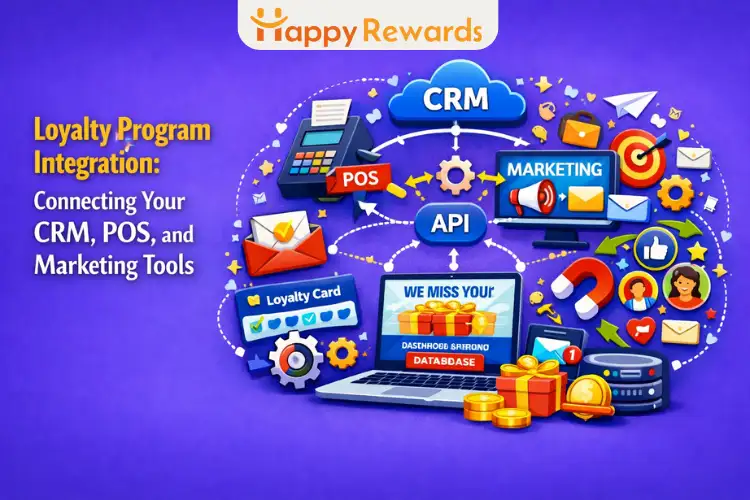
Okay, so let’s start with the basics. Loyalty program integration is the process of connecting your loyalty platform with the other tools in your business ecosystem your CRM, your POS system, your email marketing software, your e-commerce store, and more.
Think of it like plugging all the instruments in a band into the same sound system. Individually, each instrument makes noise. Together, they create music.
How Loyalty API integration is powered?
- At the technical level, this is powered by things like REST APIs, Webhooks, and SDKs that allow different platforms to communicate with each other in real time.
- Data flows between systems using structured formats like JSON, while middleware acts as a translator between tools that don’t speak the same language natively.
- More modern setups rely on microservices and headless commerce architecture, which give businesses incredible flexibility in how they build and scale their tech stack.
At its core, integration creates a Customer Data Platform (CDP) effect a unified view of every customer across every touchpoint.
Instead of your loyalty data living in one box and your purchase history living in another, integration brings it all into a single, actionable profile. And that’s where the magic of omnichannel connectivity begins.
The three core integration pillars every business should focus on? CRM, POS, and Marketing Tools. Let’s walk through each one in detail and we’ll start with the one that most businesses get wrong first.
Why Disconnected Systems Are Quietly Killing Your Loyalty Program?
Here’s something that might sting a little: your loyalty program could be losing you money right now and you might not even know it.
When your systems don’t talk to each other, you end up with data silos. Your purchase history sits in your e-commerce platform, your loyalty points balance lives in your loyalty app, and your email tool is blissfully unaware of any of it.
The result? Missed behavioral triggers. A customer who just hit your Gold tier doesn’t get a congratulations email because your email tool doesn’t know about the tier upgrade.
A customer who hasn’t shopped in 90 days doesn’t get a re-engagement campaign because your CRM can’t see their redemption rate dropping.
Over time, these missed moments chip away at your customer lifetime value and quietly inflate your churn rate.
There’s also the problem of point expiration and breakage when customers accumulate points but never redeem them, often because the experience is confusing or inconsistent. Disconnected systems make this worse.
A customer who earns points in-store but can’t see or redeem them online isn’t just frustrated they’re disengaged. And disengaged customers don’t stick around.
Poor customer segmentation means you’re sending the same messages to everyone, which tanks your retention rate and destroys the very thing your loyalty program was built to create: emotional connection.
The good news? Integration solves all of this. Let’s look at exactly how starting with your CRM.
CRM Integration: Turning Loyalty Data Into Customer Intelligence
Imagine your CRM as the brain of your entire customer operation. It knows who your customers are, what they’ve bought, how often they shop, and how they prefer to be contacted.
Now imagine feeding that brain with live loyalty data points balances, tier status, redemption history, reward preferences. That’s exactly what CRM synchronization does, and it changes everything.
The 360° Customer Profile
With proper CRM integration, every customer record is enriched with loyalty data in real-time data sync. Your sales and support teams can instantly see whether a caller is a Bronze member or a Platinum VIP and treat them accordingly.
Your marketing team can segment customers by tiered rewards status and create campaigns that speak directly to where each person is in their loyalty journey. This is the kind of personalized marketing that feels less like a blast email and more like a one-on-one conversation.
SSO, OAuth, and Seamless Authentication
A big part of smooth CRM-loyalty integration is making sure users don’t have to manage five different logins. Single Sign-On (SSO) powered by OAuth protocols allows customers to authenticate once and access their loyalty data across your website, app, and member portal seamlessly.
For your internal team, it means everyone from customer success to marketing is pulling from the same Customer Data Platform with consistent, accurate information.
Predictive Modeling and AI-Driven Rewards
Here’s where things get really exciting. When your CRM is synced with your loyalty data, you open the door to predictive modeling and AI-driven rewards. Platforms like Salesforce Loyalty Management use AI to identify customers likely to churn before they actually do allowing you to launch proactive retention campaigns.
Your Net Promoter Score (NPS) climbs because customers feel seen and valued, not spammed. And because your CRM holds the full purchase history, you can identify which VIP benefits actually drive repeat purchases versus which ones get ignored.
Popular CRM platforms for loyalty integration:
- Salesforce deep loyalty management with AI personalization
- HubSpot ideal for mid-market businesses with marketing automation needs
- Zoho CRM flexible and budget-friendly for growing businesses
CRM integration isn’t just a technical upgrade it’s a strategic one. Once you’ve got your customer intelligence layer firing on all cylinders, the next step is making sure those insights work just as well when your customers walk into your physical store. That brings us to POS integration.
POS Integration: Bridging the Online-Offline Gap
Here’s a scenario that plays out every day in retail businesses: A customer builds up a solid loyalty points balance shopping online.
Then they walk into your physical store, ready to redeem and the cashier has no idea those points even exist. The customer walks out annoyed. Maybe they never come back. This is the online-offline gap, and POS integration is what closes it.
Real-Time Earning and Redemption at the Checkout
When your loyalty platform is integrated with your Point of Sale system, customers can earn and redeem rewards right at the checkout flow with zero friction.
No apps to open, no loyalty cards to dig out. Scan a QR code, tap a phone with Apple Wallet or Google Pay, and the transaction is done.
Points update instantly thanks to real-time data sync. For businesses with high transaction volume think coffee chains or grocery stores managing latency and scalability is critical here. A well-architected POS loyalty integration handles thousands of simultaneous transactions without breaking a sweat.
Mobile Wallet Integration: The Future of In-Store Loyalty
Mobile wallet integration is one of the fastest-growing areas in loyalty tech right now. According to Square Loyalty data, customers enrolled in integrated loyalty programs spend significantly more and visit more frequently than non-members.
Giving customers a digital loyalty pass in their Apple Wallet or Google Pay means their membership is always one tap away no app download required, no login to remember.
Cart Abandonment Recovery and Batch Processing
POS integration also opens up powerful use cases like cart abandonment recovery. If a customer fills a cart online but doesn’t complete the purchase, your system can automatically trigger a personalized nudge “Hey, you’ve got enough points to get 20% off that order!”
For environments with intermittent connectivity, batch processing ensures that points earned offline are synced back to the central loyalty system as soon as the connection is restored, so no customer data ever falls through the cracks.
Popular POS platforms for loyalty integration:
- Square POS seamless built-in loyalty and marketing tools
- Lightspeed great for retail and hospitality with robust API support
- Shopify POS perfect for businesses bridging online and in-store commerce
With your POS firing loyalty data in real time, your customers get a truly unified experience no matter where they shop.
But earning points is only half the story the other half is making sure your marketing engine knows exactly when and how to reach those customers. And that’s where marketing tool integration steals the spotlight.
Marketing Tools Integration: Automating Personalized Loyalty Campaigns
Let’s be honest nobody wants to receive a generic “Thanks for being a customer!” email anymore. Customers today expect you to know who they are, where they are in their journey, and what they actually care about.
That level of personalization doesn’t happen manually. It happens when your loyalty data is fully synced with your marketing tools and it’s powered by behavioral triggers.
Automated Campaigns That Feel Human
When your loyalty platform talks to your email and SMS gateway, you can trigger highly personalized messages the moment something meaningful happens. A customer just reached the Gold tier? Instantly fire off a transactional email celebrating the milestone and revealing their new VIP benefits. Someone hasn’t shopped in 45 days?
Launch a re-engagement campaign via push notifications with a limited-time cashback offer. It’s their birthday rewards month? Surprise them with a special gift before they even think to check in. These automated micro-moments are what separate a forgettable loyalty program from one that builds real brand affinity.
Gamification: Badges, Leaderboards, and Progression Bars
One of the most powerful things you can do with integrated marketing tools is activate your Gamification API. This means syncing your loyalty program’s game mechanics badges, leaderboards, progression bars directly into your email and app campaigns.
When a customer sees that they’re 200 points away from unlocking a new badge, and they get a push notification telling them so, guess what? They go make that next purchase. Gamified rewards tap into natural human psychology and dramatically boost frequency of purchase and customer engagement.
Referral Tracking, Win-Back Strategies, and Coupon Management
Integrated marketing tools also supercharge your referral tracking and referral bonus programs. Every referral link can be tied to a specific member, tracked in real time, and rewarded automatically no manual spreadsheet management needed.
For members who’ve gone quiet, intelligent win-back strategies combine digital coupons with personalized outreach to bring them back.
And with smart coupon management, you ensure that discounts are targeted, not scattered protecting your margins while keeping customers happy. Explore how HappyRewards referral program features can automate this entire process for your business.
Popular marketing platforms for loyalty integration:
- Klaviyo powerful e-commerce email and SMS with deep segmentation
- Mailchimp accessible and beginner-friendly with solid automation features
- Attentive leading SMS gateway for loyalty-triggered mobile campaigns
The beauty of marketing integration is that it makes your loyalty program do the heavy lifting around the clock sending the right message, to the right person, at exactly the right time.
Now that you know what great integration looks like, let’s talk about how you actually build this kind of system from scratch.
How to Build a Loyalty Program Integration Strategy (Step by Step)
Alright, so you’re convinced. Integration is the way forward. But where do you actually start? Here’s a simple, no-nonsense roadmap that works whether you’re a scrappy e-commerce startup or a multi-location retail brand.
Step 1: Audit Your Existing Tech Stack
Before you can connect anything, you need to know what you’re working with. Map out every tool in your current ecosystem your e-commerce platform, your POS, your CRM, your email tool, your analytics software.
Identify which systems are modern API-friendly platforms and which are legacy systems that might require a legacy system migration strategy before they can be integrated. This audit saves you months of headaches later.
Step 2: Choose an API-First Loyalty Platform
Not all loyalty platforms are built equal. You need one that’s built on a strong REST API foundation and offers Webhooks, a developer-friendly SDK, and pre-built connectors for popular third-party apps. An API-first platform like HappyRewards.io gives you the flexibility to connect your entire tech stack without rebuilding everything from scratch.
Look for platforms that offer white-label loyalty options too, so you can keep everything on-brand.
Step 3: Map Your Data Flows
Once you’ve got your platform chosen, it’s time for data mapping. This means defining what data goes where, when, and in what format.
For example: when a purchase happens at your POS, what JSON payload gets sent to your loyalty engine? When a customer redeems a reward, how does that update flow to your CRM? Work with your technical team or your platform’s integration team to document every data flow.
This step prevents the dreaded “duplicate customer records” nightmare down the road.
Step 4: Set Up Frontend Widgets and Member Portal
Your customers need a beautiful, easy-to-use interface to engage with their loyalty program. This is where frontend widgets and a well-designed member portal come in.
Embed points balance widgets on your website, add a loyalty status component to your checkout page, and build a Dashboard UI that gives members a clear view of their rewards, tier progress, and available offers. The best part? With an e-commerce plugin, much of this can be done without heavy custom development.
Step 5: Track ROI and Optimize Continuously
Integration isn’t a one-and-done project it’s an ongoing process. Set up analytics tracking from day one so you can monitor ROI tracking, conversion rate, and engagement metrics in real time.
Use this data to A/B test your reward structures, refine your automated campaign triggers, and identify where customers are dropping off.
Building your integration strategy the right way from the start saves you enormous time and money in the future and it sets the foundation for everything else we’re about to cover, including one area that many businesses overlook until something goes wrong: security and compliance.
Security, Compliance & Data Best Practices
Okay, let’s talk about something that doesn’t always get the spotlight it deserves but can literally make or break your loyalty program security.
When you’re connecting multiple systems and moving customer data back and forth, you’re also expanding your attack surface. And with loyalty programs handling sensitive information like payment details, personal profiles, and redemption histories, you can’t afford to cut corners here.
Encryption, Tokenization, and Fraud Prevention
Every data exchange between your integrated systems should be protected with strong data encryption both in transit and at rest.
Tokenization replaces sensitive data like card numbers with non-sensitive tokens, ensuring that even if data is intercepted, it’s useless to attackers. Robust security protocols combined with smart fraud prevention rules help protect your cashback engine and points balance from bad actors who try to game the system.
This is especially critical as loyalty fraud fake accounts, points theft, coupon abuse continues to grow as an industry-wide problem.
GDPR Compliance and User Authentication
If your business operates in Europe or serves European customers, GDPR compliance is non-negotiable. This means having clear consent mechanisms for data collection, the ability for customers to request data deletion, and transparent policies on how loyalty data is used.
Pair this with secure user authentication using OAuth for third-party logins and proper digital identity management and you’ve got a foundation of brand trust that customers genuinely appreciate.
The Rise of Blockchain Loyalty
Looking ahead, blockchain loyalty and decentralized rewards are emerging as exciting solutions for businesses that want full transparency and tamper-proof liability management. While still in early adoption stages, blockchain-based points systems could eventually eliminate disputes around points balances and create entirely new models of coalition loyalty between brands.
Security isn’t just an IT concern it’s a customer trust concern. The businesses that nail their security infrastructure are the ones that earn long-term brand advocacy and grow loyal communities with confidence. And to know whether all of this integration is actually working? You need to be tracking the right numbers.
Key Metrics to Track After Loyalty Program Integration
You’ve integrated your systems. Campaigns are running, points are flowing, and customers are engaging. Now the real question is: is it actually working? Here are the metrics you should be watching closely and what they’re telling you.
- Redemption Rate: What percentage of earned points are actually being redeemed? Low redemption often means poor UX or awareness fix it before breakage becomes a liability problem.
- Customer Lifetime Value (CLV): Are integrated, loyalty-enrolled customers spending more over time than non-members? This is your single biggest indicator of program success.
- Churn Rate: Is your churn rate decreasing month over month since integration? A well-integrated loyalty program should meaningfully reduce it within 90 days.
- Average Order Value (AOV): Loyalty members consistently show higher average order value track whether integration is amplifying this effect.
- Net Promoter Score (NPS): Are your loyalty members more likely to recommend your brand? High NPS from members means your integration is creating real emotional loyalty, not just transactional engagement.
- Conversion Rate & ROI: Track the conversion rate of loyalty-triggered campaigns separately from your regular marketing campaigns this gives you a clear picture of integration ROI.
- Frequency of Purchase: Is frequency of purchase going up among loyalty members? This is the clearest signal that your program is working as a retention engine, not just an acquisition one.
Pro tip: Set up a dedicated analytics tracking dashboard that pulls from all your integrated systems loyalty, CRM, POS, and marketing into one view.
This gives you a single source of truth and helps you spot issues before they become problems. Platforms like WPLoyalty and Monday CRM offer excellent built-in analytics dashboards worth exploring. Also, explore the full breakdown of loyalty program KPIs to track on HappyRewards.
Conclusion
Here’s the truth that most businesses learn the hard way: a loyalty program is only as powerful as the ecosystem it sits in.
You can have the most generous tiered rewards, the most beautiful member portal, and the most compelling incentive scheme in your industry but if your CRM doesn’t know what your POS is doing, and your marketing tools are working in the dark, your program will always underperform.
Loyalty program integration is what transforms a simple rewards system into a genuine customer retention engine. It’s what turns data into intelligence, transactions into relationships, and one-time buyers into brand evangelists.
When your CRM, POS, and marketing tools are all speaking the same language through a unified omnichannel loyalty strategy, you’re not just running a program you’re building a competitive advantage that compounds over time through stronger brand equity, higher customer lifetime value, and a community of customers who genuinely love your brand.
The era of siloed loyalty is over. Businesses that embrace integration today are the ones that will win the long game of customer-centricity tomorrow. And the best part? You don’t have to figure it all out alone.
👉 Ready to connect your CRM, POS, and marketing tools into one seamless loyalty experience?
Explore HappyRewards.io the loyalty platform built for businesses that are serious about retention. From plug-and-play integrations to advanced gamification and real-time analytics, HappyRewards makes it easy to build a loyalty program your customers will actually love.
